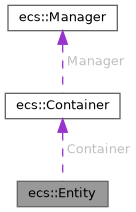
One thing in a container, to which components are attached. More...
#include <Entity.hpp>
Public Member Functions | |
| Entity (ecs::Container *container) | |
| Creates an entity with a generated handle. | |
| Entity (ecs::Container *container, const std::string &handle) | |
| Creates an entity with the given handle. | |
| nlohmann::json | Export () const |
| Describes the entity and its components as JSON. | |
| std::shared_ptr< ecs::Component > | Component (std::unique_ptr< ecs::Component > component) |
| Attaches a component to this entity and returns the stored component. | |
| template<class T = ecs::Component> | |
| std::shared_ptr< T > | ComponentGet (const std::string &type) const |
| Looks up this entity's component with the given type name, as class T. | |
| bool | ComponentHas (const std::string &type) const |
| Says whether this entity has a component stored under the given type name. | |
| void | Destroy () |
| Removes this entity and its components from the container. | |
| void | ComponentDestroy (const std::string &type) |
| Removes this entity's component with the given type name. | |
Public Attributes | |
| ecs::Container * | Container |
| The container the entity belongs to. | |
| const std::string | Handle |
| The entity's handle, given at construction and never changed. | |
Detailed Description
One thing in a container, to which components are attached.
An entity is a handle and nothing else; its data is in its components. Create one with Container::Entity().
Thread: container thread only. An entity changes its container's tables, so every member must be used from the thread that drives the container (see Container).
Constructor & Destructor Documentation
◆ Entity() [1/2]
| ecs::Entity::Entity | ( | ecs::Container * | container | ) |
Creates an entity with a generated handle.
Throws std::runtime_error if the container is null. Applications normally call Container::Entity() instead, which creates the entity and owns it.
◆ Entity() [2/2]
| ecs::Entity::Entity | ( | ecs::Container * | container, |
| const std::string & | handle | ||
| ) |
Creates an entity with the given handle.
Throws std::runtime_error if the container is null. Applications normally call Container::Entity(handle) instead.
Member Function Documentation
◆ Component()
| std::shared_ptr< ecs::Component > ecs::Entity::Component | ( | std::unique_ptr< ecs::Component > | component | ) |
Attaches a component to this entity and returns the stored component.
The call sets the component's EntityHandle and hands it to Container::Component(), which describes ownership, replacement of a component of the same Type, and the rejected inputs. In short: pass std::make_unique<T>(...) or a std::move()d std::unique_ptr; the caller's pointer is empty afterwards; a second component of the same Type replaces the first; and a null pointer, an empty Type or an entity that is no longer in its container throws std::runtime_error.
◆ ComponentDestroy()
| void ecs::Entity::ComponentDestroy | ( | const std::string & | type | ) |
Removes this entity's component with the given type name.
An unknown type name is a silent no-op.
◆ ComponentGet()
|
inline |
Looks up this entity's component with the given type name, as class T.
The result is empty when the entity has no component with that type name or the stored one is not a T. With the default T, ecs::Component, any stored component is returned. The call never throws and never changes the container. See Container::ComponentGet() for the details.
◆ ComponentHas()
| bool ecs::Entity::ComponentHas | ( | const std::string & | type | ) | const |
Says whether this entity has a component stored under the given type name.
Only the name is compared, so the component's class does not matter. The call never throws and never changes the container.
◆ Destroy()
| void ecs::Entity::Destroy | ( | ) |
Removes this entity and its components from the container.
The entity object is destroyed by the call, so the pointer must not be used afterwards.
◆ Export()
| nlohmann::json ecs::Entity::Export | ( | ) | const |
Describes the entity and its components as JSON.
Member Data Documentation
◆ Container
| ecs::Container* ecs::Entity::Container |
The container the entity belongs to.
◆ Handle
| const std::string ecs::Entity::Handle |
The entity's handle, given at construction and never changed.
The documentation for this class was generated from the following file:
- libecs-cpp/Entity.hpp